Insert HTML here

Insert HTML here

“No commodity, no program” isn’t just a mantra—it’s a harsh reality. When life-saving medications and diagnostics are not available, patients feel it, and programs cannot run. It’s the reason inventory control sits at the heart of effective public health programs. Challenges with this system will feel familiar to many programs. From paper-based stock tracking to bi-monthly reporting, managers are often left in the dark about what is really happening on the ground. Vital resources sat gathering dust in an overstocked corner, while elsewhere, understocking brought services to a screeching halt. Without real-time visibility, decision-makers were flying blind, and the timely flow of essential commodities—the very lifeline of these programs—was constantly at risk.
At ECEWS, we knew this wasn’t sustainable. We recognized that true program objectives could never be met without a responsive, data-driven supply chain system. We weren’t interested in quick fixes; we embarked on a full-blown transformation, built on two powerful pillars:
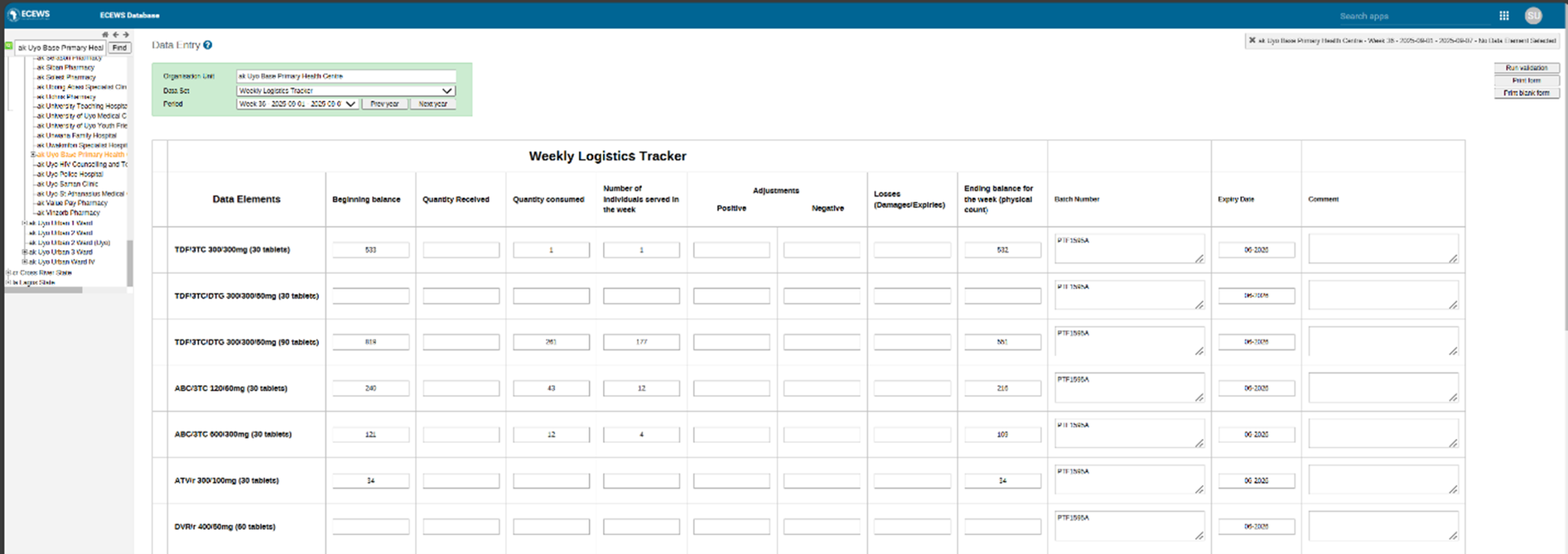
We designed a custom-built system hosted on DHIS for weekly reporting. This system enabled program managers at facilities and beyond to do real-time tracking of commodity levels, see upcoming expiries to enable prompt consumption, and align commodity utilization data with service reports.
Tools are Only as Good as Their Users:
We understood that a brilliant system is useless without empowered users. So we didn’t just deploy a tracker; we invested in the people who will use them. Healthcare workers received training, regular supervisory visits ensured best practices became ingrained habits, while integration with regular data review dashboards meant clearer oversight of commodities utilized/dispensed and alignment with service data.
This approach delivered jaw-dropping wins:
What makes this approach stand out is the fusion of technology with human-centered practice:
This is proof that when innovation meets execution, public health outcomes improve. In the realm of patient care, every accurate report, every timely alert, and every single avoided stockout isn’t just a statistic of data point—it’s a life kept on treatment, and it’s a family’s hope sustained.
To learn more about our work in ECEWS, visit our website www.ecews.org or follow us on Twitter, Facebook, and Instagram.